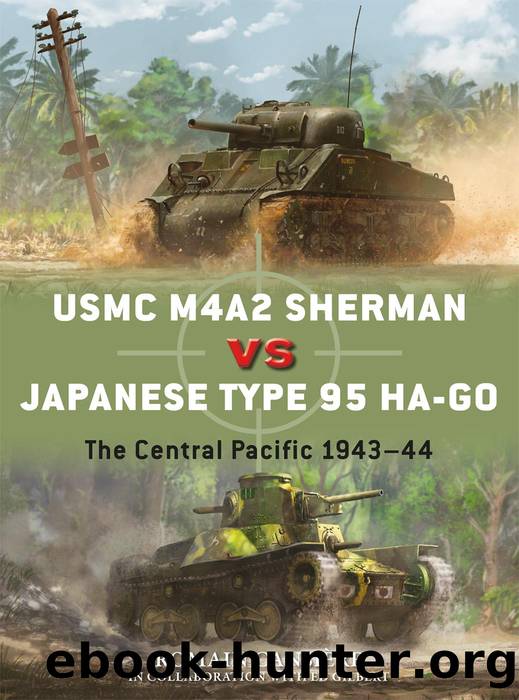
USMC M4A2 Sherman versus Japanese Type 95 HA-GO: Central Pacific 1943-44 by Romain Cansière and Ed Gilbert & Edouard A Groult
Author:Romain Cansière and Ed Gilbert & Edouard A Groult
Language: eng
Format: epub
Publisher: Bloomsbury Publishing Plc
Published: 2020-09-17T00:00:00+00:00
This Ha-Go, knocked out on a road on Saipan, shows bamboo poles mounted on the back for infantrymen to hold onto while the tank was moving. The unprotected tank riders (foreground) were usually the first victims of the powerful American fire. (MCHD)
The Japanese 9th Tank Regiment was composed of a mixture of tank models, such as this Type 95 Ha-Go (left) and Type 97 Chi-Ha (right), both knocked out on Saipan, June 17, 1944. (NARA)
American assault forces consisted of the 2nd and 4th Marine divisions and the Armyâs 27th Infantry Division. Each Marine division brought its organic tank battalion. The 4th Tank Battalion was a veteran of combat on the islands of Kwajalein Atoll in the Marshall Islands, while the 2nd Tank Battalion had seen its share of combat in the Solomons and at Tarawa. The Marine Corps did not need individual medium tank companies anymore since it was converting to all-medium tank battalions.
During training, tankâinfantry cooperation was greatly improved with the addition of a telephone to the rear of each tank so the infantry could better control tanks. In addition, jeeps were equipped with TCS radios for tank company commanders to better coordinate tank attacks with infantry at battalion level.
Better coordination with supporting arms (artillery, aviation, and naval gunfire) was also emphasized. To prevent friendly fire, large markings were painted on the tank turret tops. The 4th Tank Battalion painted the turret tops in yellow while the 2nd Tank Battalion painted large white five-pointed stars. This was to help aerial observers to better locate the front lines and thus adjust gunfire support. This time, factory-designed wading stacks were available to all tanks.
After Tarawa, Baleâs company was re-designated A Company, 2nd Tank Battalion. He recalled:
Probably some of the best combined arms training Iâve ever been through took place [in Hawaii] in the Second Marine Division. I attributed it to several things. We had lost so many people and learned so many lessons following Tarawa, and we didnât know where we were going, but we wanted to apply all those things and did not want to make the mistakes, and did not want to lose the lives. Before the division embarked and left there, the division staff laid out on the ground, using a chalk line, and said âthis is the beach, and over here is something else, and over here is a roadâ and this kind of thing. It duplicated where we were going to land. Then everybody walked through it. Didnât make any difference whether you were in tanks or the artillery or what, you walked through it. Iâve often said, I didnât say it today because I have friends out in that audience, and also panelists who would disagree violently with me, but I also think thatâand Iâve served in four Marine Divisions at one time or another between World War II and Korea and Viet Namâthe 2nd Marine Division when it left Hawaii going to Saipan was probably the best trained Marine Division Iâve ever seen.
Private First Class Robert U.
Download
This site does not store any files on its server. We only index and link to content provided by other sites. Please contact the content providers to delete copyright contents if any and email us, we'll remove relevant links or contents immediately.
Personalized inhaled bacteriophage therapy for treatment of multidrug-resistant Pseudomonas aeruginosa in cystic fibrosis by unknow(215669)
CONSORT 2025 statement: updated guideline for reporting randomized trials by unknow(102524)
Critical evaluation of the ProfiLER-02 study design and outcomes by Vivek Subbiah & Razelle Kurzrock(102053)
Cardiac gene therapy makes a comeback by Oliver J. Müller & Susanne Hille & Anca Kliesow Remes(101840)
Whisky: Malt Whiskies of Scotland (Collins Little Books) by dominic roskrow(74629)
Unveiling the design rules for tunable emission in graphene quantum dots: A high-throughput TDDFT and machine learning perspective by Şener Özönder & Mustafa Coşkun Özdemir & Caner Ünlü(51004)
A yeast-based oral therapeutic delivers immune checkpoint inhibitors to reduce intestinal tumor burden by unknow(40377)
Covalent hitchhikers guide proteins to the nucleus by Alexander F. Russell & Madeline F. Currie & Champak Chatterjee(40299)
Meet the Authors: Christopher R. Mansfield and Emily R. Derbyshire by Christopher R. Mansfield & Emily R. Derbyshire(40211)
Alkaline-earth metals promote propane dehydrogenation with carbon dioxide through geometric effects: Altering the reaction pathway by unknow(32817)
Induced iron vacancies boosting FeOOH loaded on sustainable Fenton-like collagen fiber membrane for efficient removal of emerging contaminants by unknow(32615)
Efficient electric-field-assisted photochemical conversion of methane to n-propanol exclusively over penetrated TiO2Ti hollow fibers by Guanghui Feng(32533)
Bi2SiO5 nanosheets as piezo-photocatalyst for efficient degradation of 2,4-Dichlorophenol by Hangyu Shi & Yifu Li & Lishan Zhang & Guoguan Liu & Qian Zhang & Xuan Ru & Shan Zhong(32471)
A novel NDIPTA organic heterojunction photocatalyst with built-in electric field for efficient hydrogen production by Jiahui Yang & Baojun Ma & Yongfa Zhu(32445)
Enhanced conversion of methane to liquid-phase oxygenates via hollow ferrite nanotube@horseradish peroxidase based photoenzymatic catalysis by Jun Duan & Shiying Fan & Xinyong Li & Shaomin Liu(32407)
Ordered macroporous superstructure of defective carbon adorned with tiny cobalt sulfide for selective electrocatalytic hydrogenation of cinnamaldehyde by Xiao-Shi Yuan & Sheng-Hua Zhou & San-Mei Wang & Wenbo Wei & Xiaofang Li & Xin-Tao Wu & Qi-Long Zhu(32337)
What's Done in Darkness by Kayla Perrin(27264)
Topological analysis of non-conjugated ethylene oxide cored dendrimers decorated with tetraphenylethylene: Insights from degree-based descriptors using the polynomial approach by A Theertha Nair & D Antony Xavier & Annmaria Baby & S Akhila(26636)
Investigation of mechanical and self-healing properties of hydroxyl-terminated polybutadiene functionalized with 2-ureido-4-pyrimidinone by Mohsen Kazazi & Mehran Hayaty & Ali Mousaviazar(26557)
